Establishing the Baseline Expectation
First, we established the expected distribution of venture capital by gender.
We did this by leveraging research from Deloitte's TMT 2022 Predictions report, which provides data on the gender composition of the workforce. 1
Deloitte’s report publishes the percentage of women in the workforce and the percentage of women in technical roles for the years 2019 - 2021. It contains actual figures for 2019 - 2020 and predictions of these figures for 2021 and 2022.
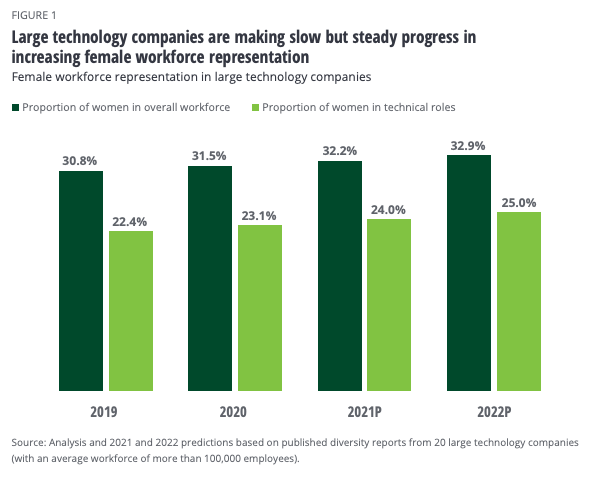
Determining Gender Representation in Technical Roles
Following the assumption that technology startups are typically eligible for venture capital funding, we used the percentage of women in technical roles as a proxy for female founder representation among venture-eligible startups. 2
Creating Our Growth Rate Model
After obtaining this historical data from Deloitte, we calculated the growth rate of the technical workforce population.
Although Deloitte has published the TMT report every year since this data was made available in 2022, the 2022 report was the last to include data on the gender composition of the workforce population. As a result, in order to calculate the funding gap, we needed to create a model that extended Deloitte’s data beyond their published projections.
We did this by…[INSERT HERE]
Accounting for Gender Identity Complexities
In our analysis, we segmented the population by male and female, which allowed us to maintain consistency with our data sources. We would have loved to visualize data based on gender identity, but based on available data, this was difficult to do.
Calculating Expected Representation
Once we had the projected percentage of women in technical roles for 2019-2024, we used this as our benchmark for what percentage of venture capital should be invested in female-only founded companies. The assumption is that funding should roughly match representation in the technical talent pool.
We then gathered actual investment data from Pitchbook's US VC Female Founders Dashboard, which publishes annual statistics on the percentage of venture capital invested in female-only startups and mixed-gender startups.
Categorizing Startup Types
Next, we created three distinct categories for our analysis:
Female-only startups
Mixed-gender startups
Male-only startups
The female and mixed-gender data came directly from Pitchbook. We determined the venture capital that went to male-only startups by subtracting the total of the other two categories from 100%.
Calculating the Funding Gap (Delta)
For each year (2019-2023), we calculate the funding gap by comparing the actual percentage of venture capital invested in each gender category against our expected percentages derived from the Deloitte technical roles data.
The formula was that the Funding Gap (Delta) is equal to
Actual Percentage of VC invested - Expected percentage based on technical role representation
Visualizing the Results
Finally, we created a data visualization showing the funding gap for each category across years.
As shown in the image, we represented the data in columns ordered from left to right:
Female-Only Funding Gap (Delta)
Mixed Gender Startups (Actual)
Male-Only Funding Gap (Delta)
This made it easy to visualize that mixed-gender startups account for most of the underfunding of female-only startups.
It also allowed us to demonstrate that, for the first time (based on the years of data we have), the actual percentage of venture capital invested in male-only startups was less than expected in 2023.
Hypothesis
2023 is an interesting year, the reason why this is significant is because it gives us a clue as to what might be happening:
There are more mixed-gender startups,
Male-only Startups are raising a lot less, or
Female-only startups have stopped seeking venture capital
It is difficult to conclude what is actually taking place in the market for venture capital unless we gather more data, but we believe our research methodology represents a profound innovation in the study of the funding gap.3
See page 104 of the PDF
One of the reasons we felt that this was a useful proxy for female founder representation in venture-eligible startups is because Deloitte's analysis covers 20 large technology companies with an average workforce of more than 100,000 employees, making it a robust dataset for our baseline.
One hypothesis is that female-only startups were building their own capital before Mark Cuban shared this advice at SXSW.